



Authored by Dr. Mary James, ND
If you’ve been feeling more tired, foggy or like your metabolism has slowed down — but your thyroid labs come back “normal” — you’re not imagining it. This is one of the most common (and frustrating) patterns women experience as they get older. In some cases, this pattern is described as subclinical hypothyroidism — where symptoms are present, but standard lab values don’t fully reflect what’s going on.
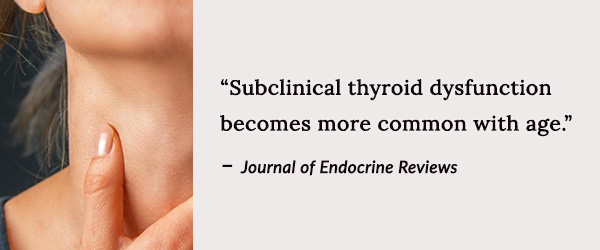
The truth is, thyroid function changes as you age — but not in the way you might think. It’s not simply that your thyroid is “slowing down.” It’s that the entire system that supports your thyroid becomes less efficient over time. And unless you understand what’s actually changing, it’s easy to miss what your body really needs.
Your thyroid isn’t failing. Your system is changing
Thyroid function depends on far more than just the gland itself. It relies on constant communication between your brain, your stress response, your liver and gut and your cells. As you age, subtle changes occur across this entire network and, over time, begin to add up.
One key shift is that your body becomes less efficient at converting T4 into T3, the active form of thyroid hormone — especially in the presence of stress, inflammation and nutrient depletion. As a result, even though your thyroid is still producing hormones, they may not work as effectively, triggering low thyroid symptoms even when TSH lab values appear normal.
Why weight gain becomes more common with age
Many women first notice changes in their thyroid through changes on the scale. Even when their eating habits haven’t changed, they find it becomes easier to gain weight and much harder to lose it.
Part of this is related to normal aging. Muscle mass naturally declines over time, reducing the number of calories your body burns at rest. But thyroid changes can make this process even more noticeable.
As your body becomes less efficient at converting T4 into active T3, your cells may receive a weaker metabolic signal. Thyroid hormones help regulate how efficiently your body produces energy, burns calories and maintains a healthy metabolic rate. When thyroid activity becomes less efficient, metabolism can slow, contributing to weight gain, fatigue and difficulty losing weight.
This is one reason many women experience symptoms commonly associated with low thyroid function even when standard thyroid tests appear normal. The issue may not be a lack of thyroid hormone production, but rather changes in hormone conversion, cellular responsiveness, stress levels, inflammation and nutrient status — factors that are often overlooked in conventional thyroid evaluations.
What actually helps support your thyroid as you age
Supporting your thyroid isn’t just about increasing hormone levels — it’s about helping your entire system work more efficiently. When the underlying systems that regulate, convert and respond to thyroid hormones are supported, your body is able to restore balance in a way that feels more natural and sustainable.
Support hormone conversion
Your thyroid produces mostly T4, but your body has to convert it into active T3 to actually feel the effects. This process depends on key nutrients like selenium and zinc, as well as healthy liver and gut function. When conversion is supported, your body can make better use of the hormones it’s already producing.


Regulate the stress response
Chronic stress can interfere with thyroid signaling at multiple levels, largely through elevated cortisol. Calming the stress response helps restore communication between the brain and thyroid, allowing hormone production and conversion to function more smoothly.
Reduce inflammation
Inflammation can block thyroid hormone activity, slow conversion and interfere with cellular response. Supporting a healthy inflammatory balance helps remove these barriers so thyroid hormones can do their job more effectively.
Replenish key nutrients
Over time, even small nutrient gaps can impact thyroid function. Providing your body with the nutrients it needs — consistently and in usable forms — helps support both hormone production and activation.
Support cellular response
Even when hormone levels are adequate, your cells need to respond to those signals. Supporting cellular health helps ensure your body can actually use thyroid hormones, which is ultimately what drives energy, metabolism and mental clarity.
When all of these systems are working together, thyroid function becomes more efficient and more balanced. This is where a comprehensive approach makes the difference. Rather than focusing on just one aspect of thyroid health, formulas like T-Balance Plus are designed to support multiple levels at once — helping nourish the thyroid while also supporting the broader systems it depends on.


Shop our solutions
Doctor-formulated. Science-backed. Proven in practice. Made in the USA. Batch-tested. FDA-inspected labs.