



Your labs say normal. Your body says otherwise.


You’re tired in a way sleep doesn’t fix. Your weight shifts for no clear reason. You feel cold when no one else does, foggy when you need to be sharp, flat when you want to feel like yourself. You’ve had your thyroid checked. Your doctor said it was fine.
Here’s what we know: “fine” is not always accurate. Research shows standard thyroid testing misses up to 75% of low thyroid cases. The American Thyroid Association estimates that 60% of women with thyroid disease don’t know they have it. So if your instincts are telling you something is off, your instincts deserve a serious hearing.
This is where we start.
What thyroid imbalance actually is
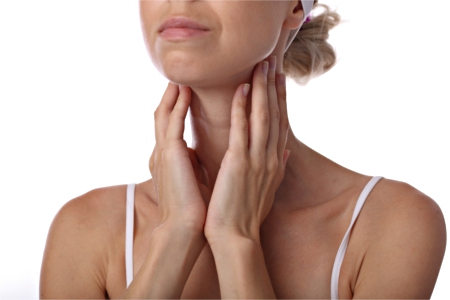
Your thyroid is a small, butterfly-shaped gland at the base of your throat. But its reach is enormous. It governs your metabolism, your energy, your body temperature, your mood, your weight, and the rhythm of nearly every organ system you have.
Think of it as the canary in the mine. When something deeper in your body goes wrong — when stress hormones surge, blood sugar swings, or your gut loses its footing — the thyroid is often the first thing to falter. And your thyroid never acts alone. Not only does it influence your whole body — your whole body interacts with your thyroid, too.
This is why thyroid imbalance is almost never just about the thyroid.
Why it’s never just your thyroid
Three systems drive most thyroid dysfunction in women.
The HPA axis and cortisol
Chronic stress floods your body with cortisol. High cortisol suppresses TSH — the signal your pituitary sends to your thyroid — and blocks the conversion of your thyroid’s raw output (T4) into the active form your cells actually use (T3). The stress comes first. The thyroid pays the price.
Insulin resistance
Blood sugar dysregulation drives inflammation. Inflammation slows thyroid hormone production and conversion. The two conditions feed each other in a loop that standard thyroid testing doesn’t capture — and that treating the thyroid alone won’t break.
Gut health
Most T4-to-T3 conversion happens in the liver and kidneys — carried out by deiodinase enzymes throughout peripheral tissue. But gut health affects that process directly. Dysbiosis drives the inflammation that impairs conversion, and a compromised gut lining reduces your absorption of the minerals that make it possible — iodine, selenium, zinc, and iron.
Address the thyroid without addressing these three, and you’re treating the smoke while the fire keeps burning.
Why so many women go undiagnosed
The standard thyroid test measures TSH — thyroid-stimulating hormone. When TSH is in range, most doctors stop there. But there’s a structural problem with this approach, and it’s worth understanding.
The TSH reference range was built decades ago on a population sample that, it later emerged, included a significant number of people with undiagnosed Hashimoto’s disease — an autoimmune thyroid condition. That contamination skewed the “normal” range upward. It means the benchmark used to judge your results was never as clean as assumed.
This isn’t doctor-blaming. It’s a systems problem — and it has real consequences for real women.
There’s a second problem. Your thyroid function can be clearly declining year after year, with every result still technically inside the “normal” range. A doctor can watch your numbers march steadily toward the boundary of dysfunction and feel there’s nothing to do until you cross it. In our view, conventional medicine is wrong about that. Waiting for full-blown disease before intervening is not prevention — it’s a missed window.
The tests that reveal actual thyroid function — Free T3 and Free T4 — measure how much active hormone your cells have available. TSH only measures the signal sent to your thyroid, not what your thyroid does with it, and not what your body does with what your thyroid produces. A woman can have a normal TSH and still have Free T3 levels too low to fuel normal energy, mood, or metabolism.
If you’ve never had Free T3 and Free T4 tested, you haven’t had a complete thyroid picture.
What actually works
We don’t believe in overriding your body. We believe in supporting it.
Your thyroid doesn’t need a synthetic hormone to replace what it’s lost — at least not before you’ve addressed what drove the loss in the first place. For many women, targeted nutritional support shifts thyroid function measurably, without the side effects that come with prescription intervention.
Selenium directly reduces thyroid antibodies in women with Hashimoto’s. Iodine is the raw material your thyroid uses to produce its hormones. Zinc and iron support the enzyme that converts T4 into the active T3 your cells can use. Coleus forskohlii activates cAMP signaling, which drives thyroid hormone production and secretion directly.
Ashwagandha has the strongest human evidence of any herb in this formula. A randomized, double-blind, placebo-controlled trial found that 600mg daily for eight weeks significantly improved TSH, T3, and T4 in adults with subclinical hypothyroidism. The researchers’ conclusion was precise: Ashwagandha normalized thyroid indices — not stimulated them indiscriminately. That distinction matters. The evidence points to restoration of the hypothalamic-pituitary-thyroid axis, most likely by reducing the cortisol-driven suppression that pushed it off-balance in the first place.
Bacopa tells a more nuanced story. Animal studies show it raises T4 significantly. In humans, its stronger case is indirect: it modulates cortisol and reduces the chronic stress signaling that suppresses T4-to-T3 conversion and blunts thyroid receptor sensitivity. For women whose thyroid struggles are stress-driven — and that’s most of them — that’s a meaningful mechanism.
Hops and sage address the hormonal and metabolic terrain that thyroid function depends on. Hops stabilizes estrogen signaling — excess estrogen raises thyroid-binding globulin, reducing the free hormone your cells can actually access. Sage supports insulin sensitivity and metabolic regulation, directly relevant because insulin resistance impairs T4-to-T3 conversion. Neither herb treats hypothyroidism directly. Both address systems that determine how well your thyroid support actually works.
Our approach brings these nutrients together in meaningful doses to address the full picture rather than one number on a lab report. T-Balance Plus was formulated with this in mind — not as a substitute for medical care, but as serious nutritional support for a system that needs more than a lab test to heal.
Find out where you stand
Thyroid imbalance isn’t one thing. It exists on a spectrum — from subtle early-stage sluggishness to full clinical dysfunction — and where you fall on that spectrum shapes what your body actually needs.
Our thyroid quiz takes about three minutes. It asks about your symptoms, your history, your energy patterns, and your stress. Based on your answers, it routes you to one of four outcome paths, each with specific guidance and support matched to your level of imbalance.
No labs required. No doctor’s referral. Just honest answers and a clear next step.
What you’ll find in this directory
Testing & Diagnosis
– Why Your TSH Can Be Normal and Your Thyroid Can Still Be Struggling
– Free T3 and Free T4: The Tests Most Women Never Get
– How to Read Your Own Thyroid Lab Results
– What to Ask Your Doctor Before You Leave the Office
Symptoms of low thyroid
– The Thyroid Symptoms Most Often Mistaken for Aging or Stress
– Why Thyroid Dysfunction Feels Different in Women
– Cold Hands, Slow Metabolism, Brain Fog: Is It Really Your Thyroid?
– Hair Loss and Thyroid: What the Connection Actually Means
Nutrition & Support
– The Five Nutrients Your Thyroid Needs Most
– Iodine and Thyroid Function: How Much Is Too Much?
– Selenium, Hashimoto’s, and Why This Mineral Matters
– Ashwagandha and Thyroid Health: What the Research Actually Shows
Stress & Thyroid
– How Cortisol Suppresses Thyroid Function
– The HPA-Thyroid Connection: Why Treating Stress Treats Your Thyroid
– Why You Can’t Rest Your Way Out of Adrenal-Thyroid Dysfunction
Hashimoto’s
– What Hashimoto’s Disease Actually Is — and Why It’s So Often Missed
– The Autoimmune-Thyroid Link: Why Your Immune System Matters
– Gluten, Gut Health, and Hashimoto’s: Separating Fact from Fear
Not sure where to start? Talk to someone.
Our health advisors take calls every weekday. They’re not sales reps — they’re women who know this territory and want to help you find your footing. Call us at 1-800-448-4919, or take the quiz and let your symptoms point the way.
Your body has been trying to tell you something. It’s time to listen.