



You’ve probably noticed it: skin that used to bounce back now feels thinner, new fine lines seem to appear every time you look in the mirror, and joints that you once never gave a second thought suddenly demand attention with every painful step. This isn’t just “aging.” It’s accelerated collagen loss — and thankfully, it’s a problem you can do something about. Here’s why women over 40 lose so much collagen, and what the science says actually helps.
What collagen actually does in your body
Collagen is the most abundant protein in the human body, making up roughly a third of total protein content. It’s the structural scaffolding behind skin elasticity, joint cushioning, bone density, gut lining integrity, and even arterial flexibility.
Production happens in fibroblast cells, which synthesize collagen from amino acids and then weave it into the dense, organized fibers that give tissue its strength. The process requires Vitamin C, zinc, copper, and specific amino acids (glycine, proline, hydroxyproline) as raw materials. When any of these inputs are limited — or when the fibroblasts themselves slow down — the whole system loses output, resulting in collagen loss.
Why the decline hits so hard after 40
Collagen production actually begins declining around age 25, but the drop is so small and gradual that most women don’t notice it. What changes during perimenopause and menopause is the rate of loss. During this window, collagen loss can pick up speed, driven by hormonal shifts, chronic stress, metabolic changes, and cumulative sun damage all working against you at once.
Understanding these factors is the first step toward protecting the collagen you have — and supporting your body’s ability to produce more.
Estrogen is a collagen regulator
Fibroblasts have estrogen receptors, and estrogen actively stimulates collagen synthesis. It also promotes the production of hyaluronic acid (which keeps collagen hydrated) and keeps the enzymes that break collagen down in balance. When estrogen levels start to fluctuate during perimenopause and menopause, all three of these functions are at risk of becoming impaired.
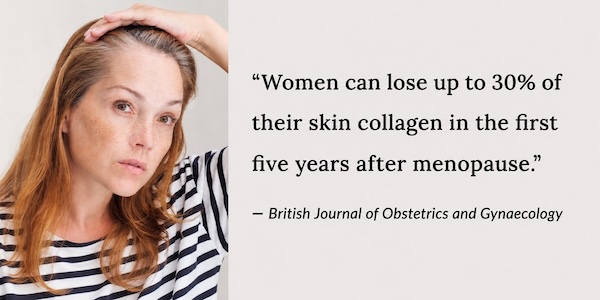
Research has shown that women lose approximately 2% of their skin collagen each year during perimenopause, and then a whopping 30% of their skin collagen in the first five years after menopause. This adds up. By the time a woman reaches her 60s, she may have lost up to 50% of her baseline collagen.
This change shows up in your skin, but collagen loss is a problem that’s more than skin deep. The same structural changes happening in skin are happening in bones, joints, and connective tissue throughout the body — which is part of why bone density, joint health, and wound healing all shift meaningfully in this window.
Cortisol compounds the problem.
Chronic stress elevates cortisol, which inhibits collagen synthesis and boosts the enzymes that break it down (a state we call “cortisol face”). Midlife is often a high-stress period, which means many women are experiencing hormonal collagen decline and stress-related collagen suppression simultaneously.
UV exposure and oxidative damage act as accelerants.
Ultraviolet radiation generates inflammatory oxidative stress and free radicals that fragment collagen fibers and disrupt fibroblast behavior. Women with significant lifetime sun exposure often see the structural effects more acutely during the menopausal transition as estrogen wanes and can no longer mask the problem.
Insulin resistance interferes with repair.
The process of glycation — where sugar molecules bind to collagen fibers — makes those fibers stiff, brittle, and more vulnerable to degradation. Insulin resistance, which increases with age and other metabolic changes, accelerates this process. High blood sugar environments essentially age collagen faster than the body can synthesize new fibers.
Still smoking (or vaping)? It’s blocking new collagen formation
Smoking and vaping expose the body to chemicals that increase oxidative stress and inflammation, accelerating collagen breakdown and interfering with the production of new collagen. They can also restrict blood flow to the skin, reducing the oxygen and nutrients it needs to repair itself. After age 40, when natural collagen production is already declining, smoking or vaping makes the damaging effects of collagen loss increasingly cumulative.
What the science says actually helps
Not everything marketed as a collagen solution is created equal. Here’s where the evidence is strongest.
Hydrolyzed collagen peptides. The research on oral collagen supplementation is strong. Hydrolyzed collagen (collagen that has been broken into smaller peptide fragments) is absorbed through the gut and has been shown to accumulate in skin tissue, where it appears to stimulate fibroblast activity and signal the body to produce more of its own collagen. Several well-designed studies have demonstrated improvements in skin elasticity, hydration, and density with consistent supplementation.
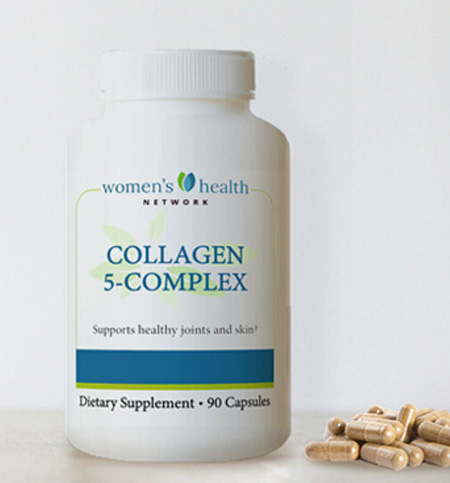
Collagen 5-Complex
Superior hydrolyzed collagen formula with all 5 types of collagen for healthy skin, joints and connective tissue
Vitamin C — non-negotiable. Vitamin C is an essential cofactor in collagen synthesis. Without adequate Vitamin C, fibroblasts cannot properly form the stable triple-helix structure of the molecule that gives collagen its strength. Adequate daily intake through whole foods (citrus, bell peppers, strawberries, kiwi) or supplementation supports the baseline Vitamin C you need.
Boost antioxidant intake. Polyphenol-rich foods — berries, green tea, dark leafy greens, pomegranate — help protect against oxidative stress and neutralize the free radicals that damage collagen fibers. For therapeutic levels of antioxidants, consider taking a high quality antioxidant supplement.
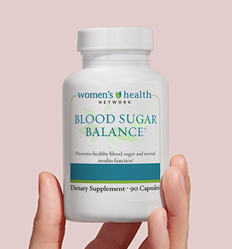
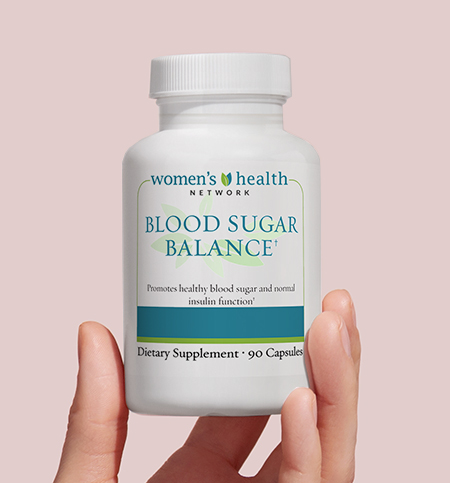
Protect against glycation. Reducing refined carbohydrates, managing blood sugar, and prioritizing foods with a lower glycemic impact directly protects existing collagen from the stiffening and fragmentation caused by glycation.
Sun protection is collagen protection. Daily SPF use is one of the highest-leverage interventions for preserving dermal collagen — not just for cosmetic reasons, but because UV damage is one of the most efficient drivers of collagen fragmentation. Limit time in the direct sun and wear sunscreen (check the ingredients carefully to avoid hormone-disrupting toxins), sun hat and protective clothing when outside for extended periods of time.
Get ample sleep. Collagen synthesis peaks during deep sleep, and growth hormone — which supports fibroblast function — is primarily secreted at night. Get the sleep you need through improved sleep hygiene: limit screen use at night, engage in soothing bedtime routines, and explore the use of sleep-restorative nutrients.
The good news in all this? While collagen loss accelerates after 40, it is not a passive process you are powerless against. Your body is constantly remodeling and rebuilding connective tissue, and the choices you make every day — from blood sugar balance and stress management to sleep, nutrition, sun protection, and targeted collagen support — can meaningfully influence how well that system functions. Collagen loss may be a normal part of aging, but it does not need to be an inevitable one.
Shop our solutions
Doctor-formulated. Science-backed. Proven in practice. Made in the USA. Batch-tested. FDA-inspected labs.