


Why is menopause such a problem?


Authored by Dr. Sarika Arora, MD
Every woman who lives long enough will go through menopause. More than 80% of us experience symptoms during the peri/menopause transition.1 And almost all of us are unsatisfied with the help we’re offered — by our doctors, our friends, influencers, the media, our culture.
Our symptoms get described as chaotic and unpredictable, our suffering as a normal part of aging. Our doctors don’t seem to listen, and blame most of it on falling estrogen. They offer drugs that few of us actually trust. We try this, try that. Then we find out menopause lasts longer than we’ve been told.
The crux of the problem: new science hasn’t transformed medical practice – or women’s beliefs.
Conventional medicine approaches menopause as a problem caused by falling estrogen that can best be fixed with HRT. Some women agree and also hope HRT has other great benefits.
But most women intuitively know it’s more complex and distrust the pharmaceutical solution. And the science shows they are mostly right – not so much about the risks, but the fact that HRT doesn’t help more than two of the 25 major symptoms of peri/menopause.2
What’s remarkable is that medical science long ago showed falling estrogen isn’t the sole cause, and that HRT has limited value. The major bodies that guide practitioners have said for years that hormone tests aren’t needed to diagnose or manage peri/menopause in women over 45.3 Other factors like your history and symptoms tell your doctor more. And they should tell you too.
One more big idea: the new science of systems medicine also vindicates that the nutrition and lifestyle changes so many women are trying (though somewhat randomly) are actually helpful in addressing these underlying causes – but doctors aren’t trained to give that guidance, and can’t within the health insurance model.
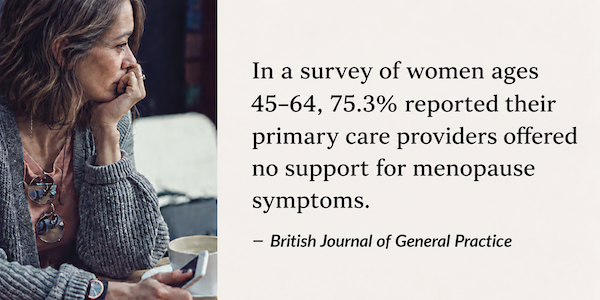
So women feel trapped, with good reason. Fewer than 1 in 20 women ages 45–54 are reported to take systemic hormone therapy.5 But keep in mind that not every woman takes a survey, and there’s evidence that a large majority never even seek medical care for their peri/menopause symptoms.4 For those who try to help themselves, every month brings a new supplement, a new protocol, an influencer’s new claims.
Let’s start over. The latest science is way ahead of the old ideas and medical practice, and your doctor can’t give you the guidance the new science says will work. Keep reading: in about 10 minutes you’ll understand what’s really happening to you, and how you can make it better.
Yes, estrogen declines.
It does. It’s why your cycle changed, and it has a great deal to do with hot flashes and changes in vaginal tissue. But it’s a weak explanation for everything else.
More than 25 symptoms are associated with peri/menopause. When researchers compared women at every stage of the transition,2 only two symptoms told the stages apart: hot flashes got worse and vaginal dryness appeared. Everything else — the exhaustion, the disturbed sleep, the mood swings, the joint pain, the brain fog, the extra weight — turned up just as often in women who weren’t in the menopause transition at all.
Those same two symptoms are the ones estrogen treatment resolves — hot flashes with systemic hormone therapy, vaginal dryness with estrogen applied directly to the tissue.19 That isn’t a coincidence. It’s what a real cause looks like — and it tells you something about the other two dozen. It’s worth exploring this more deeply in our article:
→ Falling estrogen is a weak explanation
Another group came at it the other way round. Instead of sorting women by stage, they measured hormones in the same women month after month and matched the levels against the symptoms.18 The same two came up. Hot flashes and vaginal dryness moved with the hormones. Disrupted sleep and low mood moved with none of them.
Most of what’s making you miserable isn’t specific to menopause.
Here’s a test worth running on your own symptom list.
Ask which of your symptoms a healthy 35-year-old also gets. The answer is: almost all of them. Plenty of women in their 30s are saying to themselves, “I’m too young to be in menopause!” And they have perfectly normal estrogen levels.
Those symptoms show up before and during menopause rather than because of it. Which means the answer to them isn’t declining estrogen.
There are other reasons the blame should not all fall on estrogen. But let’s first tackle another major misunderstanding to help bring the real picture into focus.
And menopause doesn’t always end, either.
You were probably told to expect a couple of rough years. That’s part of the conventional model.
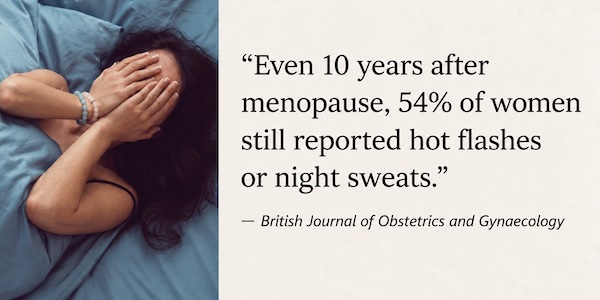
The research says otherwise. The median duration of frequent hot flashes is 7.4 years, and for women whose symptoms started early it runs more than 11 years.6 In a British study of more than 10,000 women aged 54 to 65 — an average of 10 years past menopause — 54% still reported hot flashes or night sweats.7
Vaginal symptoms are grimmer still: they don’t fade with time, they get worse after menopause, year by year.8
And they don’t follow the same rules as the rest. Enough women on oral hormone therapy still have vaginal dryness that the medical-society guidelines now treat the two problems separately — systemic therapy for hot flashes, local treatment for this — and recommend offering local treatment to women who are already taking hormones.19 The reason is that this tissue makes and uses its own hormones, largely independently of what’s in your bloodstream.20 It’s the same story as everything else on this page: what’s happening to you depends on your own biology, not on a hormone level.
This matters more than it sounds. A short, sharp transition justifies a short course of treatment. A decade or more doesn’t. If this is going to run for years, the useful question isn’t how to get through it — it’s what’s driving it.
→ It doesn’t always end, and other lessons from the data
If it isn’t just falling estrogen, and it isn’t short, what is going on here? Now the new science gets really interesting.
So where does your menopause come from?
Researchers followed more than 3,000 women for 16 years, tracking 58 separate symptoms, and found something they weren’t looking for.9
The women who struggled most through menopause were, for the most part, identifiable before it started. A quarter of them were already carrying a heavy pattern of symptoms while they were still premenopausal — and as they moved through menopause, most stayed in the pattern they started in.9
So menopause didn’t create these patterns, and it didn’t rearrange them either. What it adds, for most women, is the hot flashes and the vaginal dryness. What it doesn’t do is change which pattern you’re in.9
Whatever is happening to you now didn’t start when your period changed.
The latest science consistently shows that our health runs on ten core factors — how you take in food and use it, how you handle stress and recover from it, how you sleep and repair, how you manage inflammation, how your hormones hold steady. Over a lifetime the ten factors interact to adapt to how you’ve lived, and those adaptations accumulate into a pattern. The scientific name for this is dysregulation, and the patterns of dysregulation are called phenotypes.
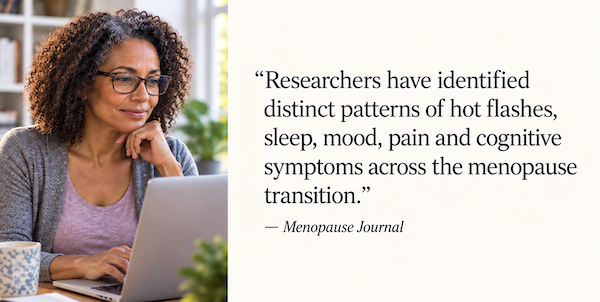
Nobody’s ten core factors interact or dysregulate exactly the same. That’s why your menopause looks like this and your sister’s looks like something else.
→ Your menopause took shape years ago — and why that matters
Besides not blaming estrogen, grasp these four new ideas.
Your symptoms aren’t random. They’re a pattern, and patterns can be read.
Your menopause has a history. It didn’t begin two years ago. It’s been forming your whole adult life.
That pattern points to your solution. It tells you which factor to work on first, instead of trying things randomly until something helps. Your symptoms describe a phenotype, and that is how your body asks for what it needs to self-regulate better.
It’s useful either way. Whether or not you take hormone therapy, this dysregulation is the part hormone therapy doesn’t address. You need to support your body’s self-regulatory power whether you choose HRT or not.
So, the secret’s out. We call your pattern your BioType™, and each BioType comes with a product bundle and protocol to help you get better.
WHN’s six Peri/Meno BioTypes™ – what’s yours?
Each of these six patterns has research behind it. What nobody has done before is put them together — and make them something you can recognize in your own symptoms.
It’s best to take our Peri/Meno BioType™ Quiz, because most women have symptoms in a couple of patterns and the Quiz helps prioritize what you should work on first. That said, here’s the short version:
- Hormone-Sensitive — You’ve always felt your hormones. Hard cycles, real PMS, and then hot flashes and night sweats you can hardly describe.
- Metabolic — The weight came on recently and sits differently. Energy crashes. Cravings that feel like they’re irresistible. Diets that used to work now don’t.
- Stress-Based — Wired when you want to be calm, flattened when you need to go. Less resilience than you used to have. Sometimes just burned-out. The quiz tells you which side of that you’re on, because they don’t call for the same support.
- Thyroid-Based — Cold when everyone else is fine. Hair thinning. Slowed down in a way nobody has fully explained. Even if your labs are normal.
- GSM-Centric — Dryness, discomfort, urgency. GSM is short for genitourinary syndrome of menopause, which is the medical name for what happens to this tissue. You may feel spillover from other BioTypes, but this is your leading concern.
- BioType Zero — Few symptoms and a gentler transition than most women get. It’s the rare signal of strong self-regulation — and your needs still change as you age, so there’s work to keep it.
Knowing yours decides what to work on first – how to help fix your dysregulation and get your body back on track. It’s not random any more.

Let’s not blame your doctor – and why that matters.
It would be easy to blame conventional doctors here. The evidence doesn’t support it. But it’s worth understanding that both women and their doctors are frustrated by the way things stand.
One large study showed that most women have a consistent set of complaints about their doctor’s menopause care. “They don’t listen.” “Their options are too narrow.” “I had to become my own expert.”10 This disappointment is consistent with WHN’s own research.
But doctors have strikingly similar frustrations. Surveys show they lack confidence in their knowledge of hormones, diet and other key factors. They wish they had more training. They feel frustrated with the limited time they have to counsel women.11 They struggle with the conflicting studies about HRT, although for most it’s the only tool they feel they have.
In other research, for women who discussed menopause with a provider, the large majority describe that provider as sympathetic.12 We don’t see that as a contradiction. It’s a sign that women know it’s the system that’s failing them, not their doctor.
Medicine is built for an encounter: test, diagnose, prescribe, follow up. What peri/menopause needs is a process that runs over months — read the pattern, learn how it works, decide what to tackle first, change several things, see what improves, adjust course.
Your doctor can get you in and out in 15 minutes and not address any of your medical concerns.
→ Menopause is an obstacle for most women. It is for their conventional doctors, too.
Why you’re hearing so much contradictory advice.
You’ve noticed that the sources contradict one another. One says hormone therapy is dangerous, the next says it’s a fountain of youth. One says your symptoms are hormonal, another says they’re not. One diet, one supplement, one expert — then a different one next month.
You’re not missing something. The information really is confusing, even overwhelming. And it’s a maze for your doctor too.
Ask doctors what makes menopause care difficult and 80% name confusing messages as their single biggest problem.13 When researchers tested 600 physicians on HRT’s risks and benefits, they got the risks right just 28% of the time, and overestimated the risks more than two-thirds of the time.14
Much of that traces to a single moment. In 2002 the large WHI trial reported increased breast cancer risk with combined hormone therapy. Prescriptions collapsed almost overnight and a generation of doctors stopped offering it. The controversy raged for years. Then in November 2025 the FDA asked manufacturers to remove those black-box warnings, and approved the first revised labels in February 2026.15 That’s a change in policy, not in biology — but it means much of what women were told for twenty years no longer appears on the label.
And the gap runs wider than one drug. Remember the guidance to skip hormone testing? Three separate clinical guidelines say it — the Endocrine Society in 2015, NICE in Britain, and the European Society of Endocrinology in 2025. That’s a decade of advice telling doctors not to test.3 But women are still being sent for blood tests.
And there’s a deeper reason the studies themselves disagree.
Look up almost any natural remedy and you’ll find one well-run trial that found an effect and a next one that found nothing. We think that’s what happens when something this individual gets tested one remedy at a time against an average woman. A treatment that helps one woman considerably and another not at all comes out of that looking like nothing at all.
But that isn’t proof that nothing works. It’s evidence that what works depends on the pattern you’re carrying. Studies like these would tell us far more if they looked within a pattern instead of across all women at once.
Nobody has yet run the trial we would want, which would test a protocol built for a woman’s own BioType against a protocol meant for everyone. If that trial were run and the pattern-focus made no difference, our argument would be wrong, and we would have to say so.
There’s no such thing as an average woman. You already knew that, for other reasons.
Hormone therapy risks and benefits
We’re not going to tell you HRT is dangerous, or that you shouldn’t take it. For some women it’s the right choice, and for some symptoms nothing else works as well. We agree that the risks have been overstated.
The FDA has approved HRT for four uses.16 Weigh that against the 25+ symptoms associated with peri/menopause: for two of them, hormone therapy works better than anything else.2
It also isn’t a miracle cure without risks, those risks clearly do increase with long-term use, and studies show doctors aren’t very good at assessing those risks.14
Two other claimed benefits are more complex than most women understand. The bone benefit is real, but it fades quickly once you stop,17 and the risks of staying on HRT indefinitely after menopause grows year by year. And many women report anti-aging benefits and many doctors promote HRT for that purpose — but the data does not support the “fountain of youth” claims.
We go into the pros and cons more deeply here:
→ What HRT can fix, and what it can’t
The point almost nobody else makes is that whether you use HRT or not, don’t skip the foundational work that supports your body’s own self-regulatory power.
That foundational work isn’t a drug and it doesn’t need a prescription. It’s food, movement, sleep, stress, and targeted support — aimed at the factors that are actually dysregulated in you rather than at a generic list. That’s the all-natural approach BioType™ identifies, and you can raise it with your doctor as a kind of “adjunct therapy” if you decide HRT is right for you.
Find your BioType™
Your symptoms show which pattern you carry into peri/menopause — and which changes will actually work for you, for symptom relief and better health.
Twenty-seven questions, about five minutes. Not a diagnosis — a way to stop guessing about where to start to help yourself feel better.
Built on independent published science, our own large database of peri/menopause quiz takers, and 25 years of thinking about what actually brings women relief.
References
- Prevalence of peri/menopause symptoms. Up to 80% of women experience vasomotor symptoms alone during the transition; additional women experience symptoms in other domains without hot flashes. Source: El Khoudary SR, Greendale G, Crawford SL, et al. The menopause transition and women’s health at midlife: a progress report from the Study of Women’s Health Across the Nation (SWAN). Menopause. 2019;26(10):1213–1227. doi:10.1097/GME.0000000000001424. PMID 31568098; PMCID PMC6784846. https://pmc.ncbi.nlm.nih.gov/articles/PMC6784846/↩
- Islam RM, Bond M, Ghalebeigi A, Wang Y, Walker-Bone K, Davis SR. Prevalence and severity of symptoms across the menopause transition: cross-sectional findings from the Australian Women’s Midlife Years (AMY) Study. Lancet Diabetes & Endocrinology. 2025;13(9):765–776. doi:10.1016/S2213-8587(25)00138-X. PMID 40720963.↩
- National Institute for Health and Care Excellence. Menopause: identification and management (NG23)—Recommendations. https://www.nice.org.uk/guidance/ng23/chapter/recommendations. Lumsden MA, Dekkers OM, Faubion SS, et al. European Society of Endocrinology clinical practice guideline for evaluation and management of menopause and the perimenopause. European Journal of Endocrinology. 2025;193(4):G49–G81. doi:10.1093/ejendo/lvaf206. PMID 41082911. Stuenkel CA, Davis SR, Gompel A, et al. Treatment of symptoms of the menopause: an Endocrine Society clinical practice guideline. J Clin Endocrinol Metab. 2015;100(11):3975–4011. doi:10.1210/jc.2015-2236. PMID 26444994. The Endocrine Society retired the 2015 guideline on October 16, 2025; it is cited as historical evidence.↩
- Kapoor E, Safwan N, Chaudhry R, et al. Addressing menopause symptoms: barriers and opportunities for improvement. Mayo Clinic Proceedings. 2025;100(11):1897–1907. doi:10.1016/j.mayocp.2025.02.018. PMID 41159992. Approximately 87% of respondents had not sought medical care for menopause symptoms; the study was conducted among primary care patients at four Mayo Clinic sites and was not nationally representative.↩
- Faubion SS, Safwan N, Saadedine M, et al. United States menopausal hormone therapy usage trends: an observational study. Mayo Clinic Proceedings. 2026;101(6):946–954. doi:10.1016/j.mayocp.2025.12.021. PMID 42223394. In 2023, systemic HT use was 1.5% among women ages 45–49 and 3.4% among women ages 50–54. Annual use required at least 180 days of filled prescriptions.↩
- Avis NE, Crawford SL, Greendale G, et al. Duration of menopausal vasomotor symptoms over the menopause transition. JAMA Internal Medicine. 2015;175(4):531–539. doi:10.1001/jamainternmed.2014.8063. https://pmc.ncbi.nlm.nih.gov/articles/PMC4433164/↩
- Hunter MS, Gentry-Maharaj A, Ryan A, et al. Prevalence, frequency and problem rating of hot flushes persist in older postmenopausal women: 10,418 British women aged 54–65. BJOG. 2012;119(1):40–50. doi:10.1111/j.1471-0528.2011.03166.x. PMID 22008610.↩
- Dennerstein L, Dudley EC, Hopper JL, Guthrie JR, Burger HG. A prospective population-based study of menopausal symptoms. Obstetrics & Gynecology. 2000;96(3):351–358. doi:10.1016/S0029-7844(00)00930-3. Waetjen LE, Crawford SL, Chang PY, et al. Factors associated with developing vaginal dryness symptoms in women transitioning through menopause: a longitudinal study. Menopause. 2018;25(10):1094–1104. doi:10.1097/GME.0000000000001130. PMCID PMC6136974.↩
- Harlow SD, Karvonen-Gutierrez C, Elliott MR, et al. It is not just menopause: symptom clustering in the Study of Women’s Health Across the Nation. Women’s Midlife Health. 2017;3:2. doi:10.1186/s40695-017-0021-y. https://pmc.ncbi.nlm.nih.gov/articles/PMC5760187/ This observational symptom-clustering study does not validate WHN’s specific BioTypes, quiz or treatment protocols.↩
- Richardson MK, Coslov N, Woods NF. Seeking health care for perimenopausal symptoms: observations from the Women Living Better survey. J Womens Health. 2023;32(4):434–444. doi:10.1089/jwh.2022.0230. PMCID PMC10079240. RegenCen. The State of Menopause Care Report: 2026 National Survey. n=1,251 women aged 35+.↩
- Jeevananthan A, Alexopoulos AS, Goldstein KM, Moreno AC. Perceptions of menopause care: a pilot survey study of providers from primary care, endocrinology, and obstetrics and gynecology. J Womens Health. 2025;34(12):1462–1471. doi:10.1177/15409996251370925. Mann C, Shah L, Eccles A, et al. Menopause care for diverse communities: a qualitative study of GP clinician experiences. Br J Gen Pract. 2025;75(761):e824–e831. doi:10.3399/BJGP.2024.0780.↩
- Anderson GO, Gelfeld V. Menopause experiences: opportunities for improvement in education and healthcare. Washington, DC: AARP Research; July 2018. doi:10.26419/res.00240.001.↩
- Singh B, Liu XD, Der-Martirosian C, et al. A national probability survey of American Medical Association gynecologists and primary care physicians concerning menopause. Am J Obstet Gynecol. 2005;193(3 Pt 1):693–700. doi:10.1016/j.ajog.2005.02.080.↩
- Williams RS, Christie D, Sistrom C. Assessment of the understanding of the risks and benefits of hormone replacement therapy (HRT) in primary care physicians. Am J Obstet Gynecol. 2005;193(2):551–558. doi:10.1016/j.ajog.2005.03.061.↩
- US Food and Drug Administration. FDA Requests Labeling Changes for Menopausal Hormone Therapies. November 10, 2025. US Food and Drug Administration. FDA Approves Labeling Changes to Menopausal Hormone Therapy Products. February 12, 2026.↩
- US Food and Drug Administration. Prescribing information: Premarin (conjugated estrogens) tablets. Approved uses vary by product; no single formulation carries all four uses.↩
- Simon JA, Wehren LE, Ascott-Evans BH, et al. Skeletal consequences of hormone therapy discontinuance: a systematic review. Obstet Gynecol Surv. 2006;61(2):115–124. doi:10.1097/01.ogx.0000189152.95070.f8. Karim R, Dell RM, Greene DF, et al. Hip fracture in postmenopausal women after cessation of hormone therapy. Menopause. 2011;18(11):1172–1177. doi:10.1097/gme.0b013e31821b01c7. PMCID PMC3511047.↩
- Woods NF, Smith-DiJulio K, Percival DB, Tao EY, Taylor HJ, Mitchell ES. Symptoms during the menopausal transition and early postmenopause and their relation to endocrine levels over time: observations from the Seattle Midlife Women’s Health Study. Journal of Women’s Health. 2007;16(5):667–677. PubMed.↩
- American Urological Association, Society of Urodynamics, Female Pelvic Medicine & Urogenital Reconstruction and American Urogynecologic Society. Genitourinary Syndrome of Menopause Guideline. 2025. See recommendations on local low-dose vaginal estrogen, including for patients already using systemic estrogen. Full guideline.↩
- Science of intracrinology in postmenopausal women. PubMed record. Describes local conversion of adrenal DHEA into active estrogens and androgens; this mechanism does not establish that vaginal symptoms are independent of systemic hormonal changes.↩