



Authored by Dr. Mary James, ND
Conventional wisdom tells women to brace themselves for the aging process: get ready for your body to change, your looks to go downhill and your skin to head south.
Cosmetic companies make billions of dollars from women’s fear of aging skin, with new anti-aging products and topical “miracle” products launched every year. From our experience we find that these products mostly wind up half empty and jammed in the back of the medicine cabinet.
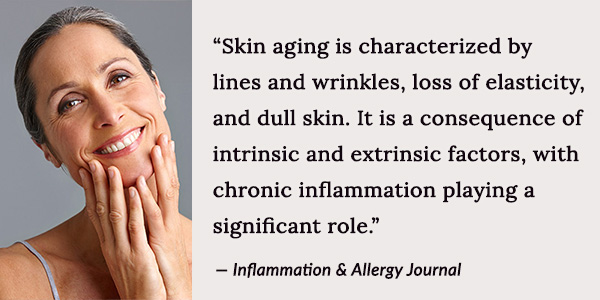
The good news is that beneath all the marketing hype there has been an authentic leap forward in our understanding of what causes skin to age, and it centers around inflammation.
This advance means your skin really can look better than ever — no matter how old you are — once you recognize that what happens on the inside truly does show up on the outside. Aging skin is biological — not chronological — and the process can be delayed or even reversed with a holistic, natural approach that includes optimal diet, lifestyle and product choices.
Inflammation and skin
By the time a woman notices visible signs of aging (usually in her late 30’s or early 40’s), it’s highly likely that her body’s been operating with low-grade inflammation for years.
Inflammation is ideally a normal, short-term natural immune response that involves the release of immune cells by your body to counteract infection and heal trauma. At that point, this response is supposed to be turned off. But if it stays activated, immune cells will remain in circulation and can damage healthy cell functions like natural skin rejuvenation and turnover.
Internal causes of inflammation
- Undiagnosed food sensitivities & leaky gut
- High-sugar diet
- Additives, artificial sweeteners and trans fats
- Stress
- Hormonal imbalance
- Toxin or prescription drug overload
- Sedentary lifestyle
- Autoimmune disorders
External causes of inflammation
- Sun exposure
- Weather
- Yeast, bacteria, parasites and/or other infections
- Environmental toxins and pollution
- Smoking
- Certain chemicals in skincare and other self-care products
Inflammation is collagen’s worst enemy
Collagen is the structural protein that keeps skin firm, smooth and resilient. Production naturally declines with age and as a result of stress. But ongoing inflammation makes collagen loss worse by disrupting the fibroblasts that build new collagen and elastin. During active inflammation, enzymes called collagenases become overstimulated and degrade collagen fibers faster than your body can replace them.
Eating too many processed foods high in sugar and other refined carbs fuels inflammation, and also poses special risks for the body’s natural collagen. High-glycemic foods trigger a process in which sugar molecules in the blood bond to proteins and DNA. Over time this process affects collagen proteins the body produces, changing their shape, flexibility, elasticity and function. The result of this “collagen dysfunction” can be premature aging in the skin (a phenomenon known as “sugar sag”).
The good news is that when you calm inflammation (see tips below) and nourish your skin from within, you can help reactivate your body’s natural collagen renewal. For immediate help, you can boost your collagen levels right now by taking a high-quality collagen supplement.
The 2-step plan for deep inflammation repair
To calm inflammation and prevent it from harming your skin, you need to approach inflammation relief on two fronts:
1. Neutralize free radicals (unstable oxygen molecules created by the above causes) both inside and out.
2. Boost immune function through good nutrition, supplementation, hormonal balance, detoxification and topical support.
Neutralizing free radicals — antioxidants to the rescue!
Many of the causes of inflammation listed above create free radicals in the body, which leads to inflammation. Free radicals are highly unstable oxygen molecules missing a single electron in their outermost orbits. Since electrons are driven to travel in pairs, free radicals “steal” electrons from healthy cells which wounds those cells and sets off a complicated inflammatory response.
Antioxidants are molecules that inhibit the oxidation of other molecules. They neutralize free radicals and quench minor inflammation by “sacrificing” one of their electrons without adverse effect. Since free radicals are always present in our bodies, we must have a constant supply of antioxidant nutrients to keep our skin cells healthy. In addition, research shows that antioxidants may actually encourage our cells’ enzymes to repair damage. This is why a high-quality multivitamin with antioxidants like the one we offer in our SHOP is a good idea. Cells have a wonderful ability to heal themselves, but this mechanism becomes less efficient as we grow older.
Some major antioxidants helpful to the skin:
- Vitamin C (found in plant-based foods)
- Vitamin E, specifically high-potency tocotrienols (good sources are rice bran oil and palm fruit oil)
- Coenzyme Q-10 (or ubiquinol, found naturally in our cells but decreases after age 20)
- Alpha-lipoic acid (ALA, available from both plant and animal sources)
- Dimethylaminoethanol (DMAE, found in fish)
- Carotenoids (phytonutrients found in the red, yellow and orange flesh of plant leaves, flowers and fruits)
- Bioflavonoids (good sources include green tea, soy isoflavones, red wine and other plant-derived foods)
Good reasons to go with organic skin products
The average woman uses 5–12 different products on her skin each and every day — basically an untested chemical soup with unpredictable results. If one of my patients has a skin or hair concern, the first thing I tell her is to go home and toss out any products that contain synthetic chemicals (which often means all of them).
Synthetic additives in cosmetics are largely unregulated by the FDA, yet many of these compounds have been proven to disrupt health on several levels. And some chemicals used in mainstream cosmetics and creams can generate free radicals and inflammation, undermining the products’ claims of being youth-enhancing.
When looking for skin (and hair) care products avoid the following harmful ingredients:
- Propylene glycol
- Phthalates
- Sodium lauryl sulfate
- Parabens
Phthalates in particular have recently been reviewed by an expert panel that found several potential health risks associated with exposure. Unfortunately, phthalates are found nearly everywhere, including cosmetics and lotions, so the best way to reduce your exposure is to go organic.
Luckily, a growing number of reasonably priced natural alternatives have entered the market. Because of an increase in demand, many companies are creating skin care products free of chemicals that are suspected of causing cancer or birth defects.
To further research the safety of ingredients of a particular product, visit the Campaign for Safe Cosmetics website.
Be good to your skin
When you look in the mirror, gaze beyond the minor imperfections and laugh lines to the glowing spirit that lies within. The best way to honor the skin you were born in is by taking the best possible care of yourself. You and your skin both deserve it!
References and further reading
References
Echtay, K., et al. 2003. EMBO J., 22 (16), 4103–4110.
Hampton, T. 2005. Study reveals mitochondrial role in aging. JAMA, 294 (6), 672.
Hashiro, M., & M. Okumura. 1998. The relationship between the psychological and immunological state in patients with atopic dermatitis. J. Dermatol. Sci., 16 (3), 231–235.
Hashiro, M., & M. Okumura. 1997. Anxiety, depression and psychosomatic symptoms in patients with atopic dermatitis: Comparison with normal controls and among groups of different degrees of severity. J. Derm. Sci., 14 (1), 63–67.
URL’s (accessed 12.30.2005):
https://cerhr.niehs.nih.gov/news/index.html
https://cerhr.niehs.nih.gov/chemicals/dehp/DEHP__Report_final.pdf
Websites
General information:
www.ewg.com
www.safecosmetics.org
On pthalates:
https://cerhr.niehs.nih.gov/chemicals/dehp/DEHP__Report_final.pdf
https://www.safecosmetics.org/about/reports.cfm
On glycation:
www.legendarypharma.com/glycation.html
On skin anatomy:
https://www.nuskin.com/corp/science/skinscience/skin_anatomy.shtml
On acne:
https://www.nuskin.com/corp/science/skinscience/acne.shtml
https://www.dfw.com/mld/dfw/13404526.htm
On rosacea and the mind-body connection:
https://www.drnorthrup.com/womenshealth/healthcenter/
https://www.drnorthrup.com/womenshealth/healthcenter/topic_details.php?topic_id=56
On doshas and body types:
https://www.indiaoz.com.au/health/ayurveda/bodytype.shtml