


Authored by Dr. Mary James, ND
While food cravings are a frustrating distraction, they also contribute to weight gain, depression and a tendency to beat yourself up. Of course, changing eating habits does require some self-discipline, but food ‘addiction’ also has a very physical basis. That means that you CAN regain control of what you eat, as well as your weight and self-esteem.

Physical factors that contribute to food cravings
It may feel as if your cravings are all in your head, but science paints a very different picture. Understanding what causes killer cravings will make you less helpless when they hit so you can finally gain the upper hand.
1. The hormonal causes of cravings
Our bodies produce numerous peptides (molecules with 2 or more amino acids) that naturally suppress hunger when we’ve eaten enough. We also make hunger-stimulating peptides, but these are far outnumbered by the ones that inspire us to put our fork down. Eating protein puts the strongest brakes on your appetite, whereas fat has hardly any effect. So when you eat more fat and less protein, you’ll be driven to keep eating.
You also have two powerful hormones controlling hunger — leptin and ghrelin, both of which are strongly influenced by sleep. Leptin, which is produced during sleep, curbs your hunger throughout the day. Ghrelin is inhibited by sleep and it makes you hungry, especially for salty, sweet and high-fat foods — the ones that can get you into trouble. A 2014 study showed that when overweight people got 90 more minutes of nightly sleep, it reduced cravings for sweet and salty foods by 62%!
If you’re craving French fries:
Choose a serving of sweet potato fries drizzled in olive oil and baked for 30 minutes at 425°.
If you’re craving ice cream:
Scoop ½ cup of “slow-churned” ice cream into a pretty dish and enjoy.
If you’re craving candy:
Munch on a handful of trail mix with nuts, dried fruit and some dark chocolate chips.
If you’re craving steak:
Enjoy two baked, lean pork chops — they have ½ the fatty calories of one whole flank steak.
2. Suppressed GLP-1 signaling
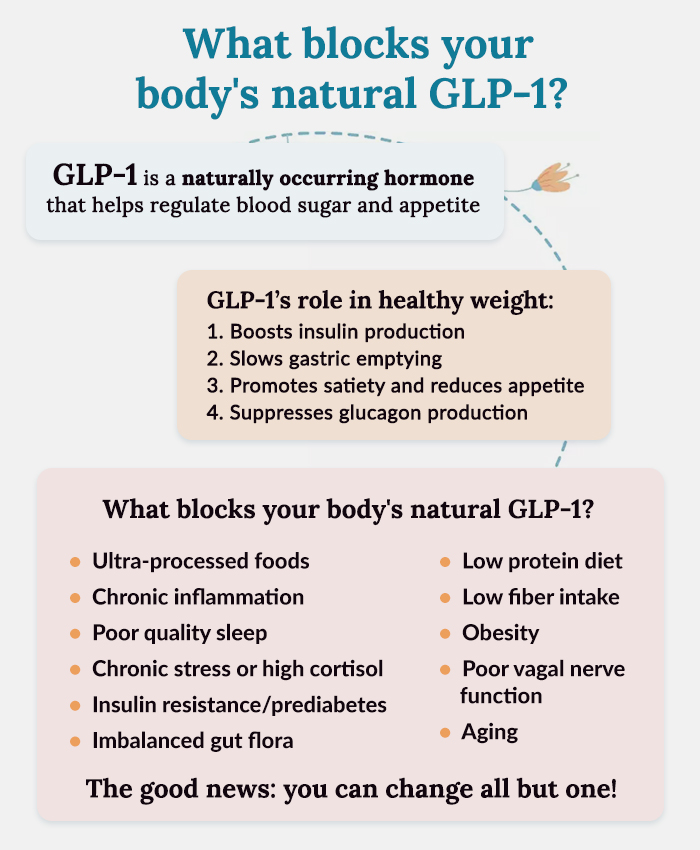
GLP-1 is a hormone your body naturally releases after eating to help regulate blood sugar, slow digestion and signal fullness to the brain. When GLP-1 levels are low or its signaling is suppressed, your body may not register satiety properly, leading to stronger and more frequent cravings. Supporting healthy GLP-1 activity through balanced meals with adequate protein and fiber, regular movement, and targeted nutrients can help restore this fullness signal and reduce the drive to overeat.
3. Blood sugar
Your body, especially your brain, needs glucose for energy, and carbohydrates boost blood sugar in a flash. But eating sweets and refined carbs can backfire — when blood sugar spikes, insulin can overshoot the mark, causing a blood sugar crash. Suddenly, the only clear message from your brain is, “Bring on more sugar!” As your body adjusts to these swings, you get out-of-control sugar cravings. So the more you eat carbs that break down quickly, like those with white-flour and/or sugar, the stronger your drive will be to consume them.
4. Drug-like effects of sugar and salt
The near-universal love of chocolate has been attributed to the various physiologic effects of its 300+ chemicals. Chocolate’s biggest lure, though, may simply be its high fat and sugar content. Brain studies show that high-fat–high-sugar foods can act on your brain in the same way as addictive opiates like cocaine and heroin. The ‘reward’ areas in your brain light up when you eat highly palatable foods. These same foods stimulate dopamine, the ‘reward’ neurotransmitter that drives us to seek out pleasure. Binge eaters who are injected with a drug that blocks the effects of opiates are suddenly less interested in foods rich in sugar and fat.
High-fat foods and those that raise blood glucose quickly are typically the ones that your brain wants most. Fast foods, including processed snacks, are designed with this in mind — you’ve been trained to want them! When you succumb, you end up returning for more … and more. When given the choice of a salmon salad or a cheesy pizza, your brain knows what it wants, even if your conscience might argue the point.
Psychological factors can fuel food cravings
While these physical factors are at play in all of us, psychological factors are having a strong influence too. Our taste buds make eating pleasurable and the oral satisfaction of eating is primal. Eating is an important means of social connection. We use it for reward, distraction and of course, comfort. After all, you can’t not eat.
Note: If you’re prone to binging or purging, you may have more than just intense cravings. You may have an eating disorder that could be endangering your health. Seek out psychological support because it can be very difficult to turn around by yourself.
How to stop food noise
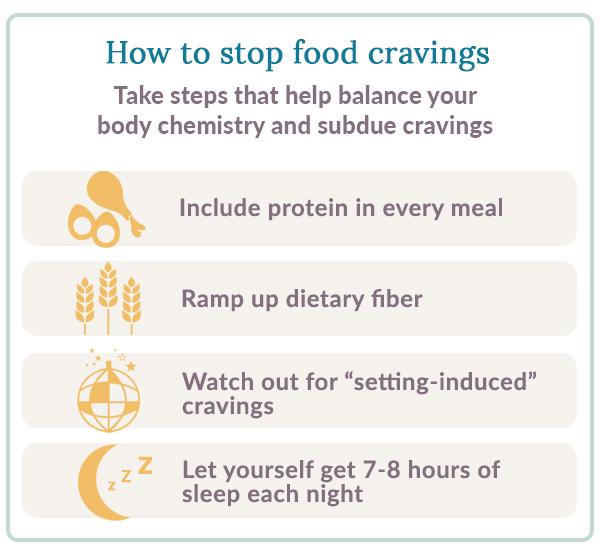
No matter where you fall on the spectrum of food cravings, taking steps to balance your body chemistry and quiet the internal “food noise” can make a huge difference. With just a few new habits, research has shown that even the physiology of overweight binge-eaters can change in ways that dramatically reduce compulsive cravings and the mental chatter that fuels them.
1. Start by including protein in every meal, especially breakfast. A high-protein morning meal helps steady blood sugar, regulate appetite hormones and silence food noise before it starts. Experiment with easy recipes and colorful spices so your meals feel satisfying and enjoyable.
2. Next, ramp up your dietary fiber to feel fuller and more grounded throughout the day. The simplest way to do this is by adding a few extra servings of fruits and vegetables. This not only reduces cravings but also supports healthy weight loss.
3. Be mindful of setting-induced cravings — like the sudden urge for a bucket of buttered popcorn simply because you walked into a movie theater. If you want it, enjoy a small portion and skip the added butter.
4. Prioritize 7–8 hours of sleep each night by getting to bed at least an hour earlier. Lack of sleep heightens food noise and intensifies cravings by disrupting key hormones like ghrelin and leptin.
5. And when you notice a craving bubbling up, pause and turn inward. That 3:00 p.m. cookie might briefly distract you from stress, boredom or uncomfortable emotions, but those feelings will be right there waiting when the last bite is gone — along with guilt. Instead of automatically eating, ask what you really need: a break, a hug, a moment of compassion or a chance to express unspoken emotions.
Quieting food noise and calming cravings is a process, but with consistent steps, your internal chemistry shifts — and so does your relationship with food.
Letting go of your cravings
Slow down when you eat so you can really taste the individual flavors in each food. When you fill your plate with quality proteins, vegetables, whole grains, legumes and fruit for dessert, I promise your cravings will begin to fade.
Ask yourself what kind of “reward” matters most in your life. Truly nourish yourself by taking a yoga class, joining a hiking club or going on a bike ride with a friend. As you feel stronger and better about yourself, junk foods will not seem nearly as alluring.
Spiegel K, Tasali E, Penev P, Van Cauter E. Brief communication: Sleep curtailment in healthy young men is associated with decreased leptin levels, elevated ghrelin levels, and increased hunger and appetite. Ann Intern Med. 2004 Dec 7;141(11):846-850.
Gilhooly CH, Das SK, Golden JK, et al. Food cravings and energy regulation: the characteristics of craved foods and their relationship with eating behaviors and weight change during 6 months of dietary energy restriction. Int J Obes (Lond). 2007 Dec;31(12):1849-1858.
Deckersbach T, Das SK, Urban LE, et al. Pilot randomized trial demonstrating reversal of obesity-related abnormalities in reward system responsivity to food cues with a behavioral intervention. Nutr Diabetes. 2014 Sep 1;4:e129.
Lennerz BS, Alsop DC, Holsen LM, et al. Effects of dietary glycemic index on brain regions related to reward and craving in men. Am J Clin Nutr. 2013 Sep;98(3):641-647.
Schulte EM, Avena NM, Gearhardt AN. Which foods may be addictive? The roles of processing, fat content, and glycemic load. PLoS One. 2015 Feb 18;10(2):e0117959.
Drewnowski A, Krahn DD, Demitrack MA, et al. Taste responses and preferences for sweet high-fat foods: evidence for opioid involvement. Physiol Behav. 1992 Feb;51(2):371-379.
Tasali E., Chapotot F., Wroblewski K. & Schoeller D. (2014). The effects of extended bedtimes on sleep duration and food desire in overweight young adults: A home-based intervention., Appetite, PMID: 24858836