



Authored by Dr. Sharon Stills, NMD
Chronic high cortisol can make it nearly impossible to balance your hormones, maintain steady energy or feel like yourself. Over time, elevated cortisol doesn’t just cause discomfort — it can contribute to serious health concerns including heart disease, cognitive decline, metabolic disorders and accelerated aging.
The empowering news? You are not powerless. Understanding cortisol’s role — and how to regulate it — is the first step toward restoring balance.
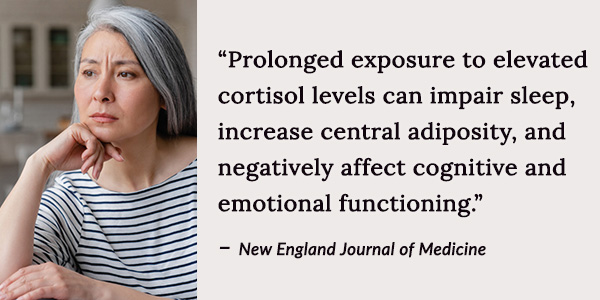
What is cortisol?
Cortisol is your body’s primary stress hormone, released by the adrenal glands. It plays a critical role in survival and everyday health.
When you face a stressor, cortisol helps by:
- Mobilizing glucose and fat for quick energy
- Supporting blood pressure and circulation
- Regulating inflammation
- Helping maintain alertness and focus
Even when you aren’t stressed, cortisol quietly supports metabolism, immune function and circadian rhythm.
Your natural cortisol rhythm
Under healthy conditions, cortisol follows a daily rhythm:
- Midnight–4 a.m.: Lowest levels
- Morning (around 8 a.m.): Peaks to help you wake up
- Daytime: Gradually declines
- Evening: Continues lowering to prepare for sleep
Temporary stress causes cortisol to rise — then return to normal once the stress passes.
Chronic stress disrupts this rhythm, keeping cortisol elevated and the nervous system on high alert.
Signs of high cortisol in women
When cortisol remains elevated, the body shifts into survival mode. This can trigger a cascade of symptoms:
Common symptoms of high cortisol:
- Insomnia or poor sleep
- Weight gain (especially belly fat)
- Fatigue and burnout
- Brain fog and poor concentration
- Low libido
- Slow healing and tissue repair
- Wrinkles, fine lines
- Stretch marks
- Digestive disruption
- Frequent illness or lowered immunity
- Hormone imbalances (estrogen, progesterone, DHEA, testosterone)
- Muscle and bone loss
- Mood swings, anxiety or depression
- Hair thinning and skin issues
- Thyroid dysfunction
Because cortisol affects nearly every system, symptoms can appear widespread and confusing.
Lab testing for high cortisol levels
Unfortunately, conventional tests for high cortisol aren’t very helpful. Typical lab cortisol tests only identify the most severe cases of cortisol dysfunction after they have progressed to a full-blown disease state, such as Addison’s Disease or Cushing’s Disease. But you may be able to find a practitioner willing to do salivary cortisol testing, which measures a hormone called DHEA (dehydroepiandrosterone) throughout the day. But these tests aren’t perfect, either.
Absent a disease state, you can gain useful insight into your cortisol “curve” by watching your own symptoms throughout the day. Pay attention to your body. If your energy level is very low in the morning but seems to increase around the time everyone else is going to bed, your cortisol cycle is dysregulated. This is a good indication that you will reap huge benefits by taking steps to rebalance your adrenal glands.
How to lower high cortisol
In our experience, women with mild to moderate adrenal imbalance have several options that can help them feel significantly better while keeping symptoms from becoming more severe.
The key is taking the right steps to normalize cortisol levels and restore healthy adrenal function. You can take immediate action by asking yourself these simple questions:
Are you eating in tune with your natural cortisol curve?
- When you eat your meals is just as important as what you eat to rebalance your adrenal glands. The goal is to achieve more stable energy levels throughout the day, which you can accomplish by eating three balanced meals with two snacks.
- What you eat does make a difference too! Try to reduce refined carbohydrates — such as sugar, flour, potatoes and white rice — which cause stressful ups and downs in your blood sugar that can lead to adrenal imbalance. We know this can be difficult, so just do the best you can. The goal is progress, rather than perfection!
How can nutritional supplements support your cortisol levels?
- High-quality vitamins and minerals help support a healthy metabolism and hormonal balance, which contribute to adrenal health. Our Essential Nutrients, with 30 vitamins and minerals, is an easy-to-take formulation that builds a strong nutritional foundation.
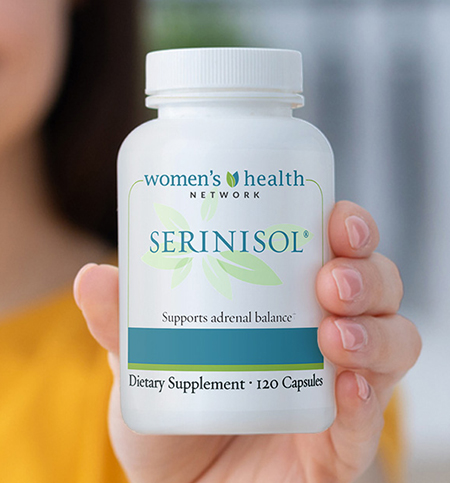
- Specific herbal supplements, such as astragalus root and eleuthuro (Siberian ginseng), are effective at reducing the negative side effects of stress. Others, such as passionflower, produce calming effects and encourage sleep. Many of these herbs are found in our natural formulations Adaptisol and Serinisol.
- Supplement with Collagen. Chronic high cortisol doesn’t just affect your mood and energy — it also accelerates the breakdown of your body’s natural collagen, the structural protein that keeps skin firm, resilient and hydrated. Over time, elevated cortisol can contribute to thinner skin, wrinkles, slower wound healing and loss of elasticity. Supplementing with collagen provides the amino acids your body needs to support healthy collagen production, helping maintain stronger connective tissue and healthier-looking skin as you work to restore cortisol balance.
- The herb Ashwagandha deserves a special call out. Ashwagandha is an adaptogenic herb that helps the body respond more effectively to physical and emotional stress. Research suggests that ashwagandha extracts may help reduce perceived stress, support better sleep and lower cortisol levels. This may make it especially helpful for women who feel “tired but wired,” have difficulty winding down or notice that chronic stress is affecting their energy and resilience. Our Bioative Ashwagandha in liquid liposomal form is highly absorbable for best results.
Which lifestyle changes are best to restore cortisol balance?
- We can’t always reduce stress, but we can take steps to reduce its effects on our lives. Take time to understand where your stress is coming from, and then think about how you’ll make changes that are right for you and your lifestyle. It’s helpful to make a list of stressors that interfere with your well being, especially those that are ongoing or self-imposed.
- Get more rest. Your body needs down time to heal! Aim for at least 7-8 hours a night. So be in bed and sleeping by 10 or 10:30 p.m. at the latest. If you need to unwind, or it takes you a little bit to fall asleep, then get to bed at 9 or 9:30 p.m.
- Get more gentle exercise. Choose forms of physical exercise that calm you down instead of rev you up. For example, walking, yoga, Tai Chi and other forms of low impact exercise can do wonders for the adrenals. On the other hand, high intensity exercise can trigger cortisol production. So listen to your body. If a certain form of exercise makes you feel worse instead of better, move on and try something else.
Remember, it took a lot of time for high cortisol levels to develop so it’s going to take time to bring your adrenals back to balance. Above all, as you work towards this goal, be kind to yourself, be proactive about all the many changes you can make and steps you can take — and know that you will be well again!
References and further reading
Hyman, M. 2005. Chapter 26. Clinical approaches to environmental inputs, 357. In Textbook of Functional Medicine. Gig Harbor, WA: Institute for Functional Medicine.
Williams, G., & Dluhy, R. 2005. Chapter 321. Disorders of the adrenal cortex, 2127–2130. In Harrison’s Principles of Internal Medicine, 16th Edition. NY: McGraw–Hill.
McEwan, B. 2006. Protective and damaging effects of stress mediators: Central role of the brain. Dialogues Clin. Neurosci., 8 (4), 367–381. (accessed 07.07.2010).
Head, K., & Kelly, G. 2009. Nutrients and botanicals for treatment of stress: Adrenal fatigue, neurotransmitter imbalance, anxiety, and restless sleep. Alt. Med. Rev., 14 (2), 114–140. (accessed 07.07.2010).
Wilson, J. 2001. Adrenal Fatigue, the 21st Century Stress Syndrome, 268–273. Petaluma, CA: Smart Publications.
Lawnson, E., et al. 2009. Hypercortisolemia is associated with severity of bone loss and depression in hypothalamic amenorrhea and anorexia nervosa. J. Clin. Endocrinol. Metab., 94 (12), 4710–4716. (accessed 07.06.2010).
Sbaihi, M., et al. 2009. Cortisol mobilizes mineral stores from vertebral skeleton in the European eel: An ancestral origin for glucocorticoid-induced osteoporosis? J. Endocrinol., 201 (2), 241–252. (accessed 07.06.2010).
Sivamani, R., et al. 2009. Stress-mediated increases in systemic and local epinephrine impair skin wound healing: Potential new indication for beta blockers. PLoS, 6 (1), e12. (accessed 07.07.2010).
Head, K., & Kelly, G. 2009.
Scherrer, U., & Sartori, C. 1997. Insulin as a vascular and sympathoexcitatory hormone. Circulation, 96, 4104–4113. (accessed 07.07.2010).
Beluche, I., et al. 2010. A prospective study of diurnal cortisol and cognitive function in community-dwelling elderly people. Psychol. Med., 40 (6), 1039–1049. (accessed 07.07.2010).
Hays, B. 2005. Chapter 19. Hormonal imbalances: Female hormones: The dance of the hormones. Pt. I, 229. In Textbook of Functional Medicine. Gig Harbor, WA: Institute for Functional Medicine.
McEwan, B. 1998. Protective and damaging effects of stress mediators. NEJM, 338 (3), 171–179. (accessed 07.07.2010).
Wilson, J. 2001. Adrenal Fatigue, the 21st Century Stress Syndrome, 290. Petaluma, CA: Smart Publications.
Hardy, R., & Cooper, M. 2010. Adrenal gland and bone. Arch. Biochem. Biophys., 503 (1). 137–145. (accessed 07.07.2010).
Isales, C., et al. 2010. ACTH is a novel regulator of bone mass. Ann. NY Acad.Sci., 1192 (1), 110–116. (accessed 07.07.2010).
Riva, R., et al. 2010. Fibromyalgia syndrome is associated with hypocortisolism. Int. J. Behav. Med. [Epub ahead of print.] (accessed 07.07.2010).
Hays, B. 2005. 229–230.
Zarković, M. 2003. [Disorder of adrenal gland function in chronic fatigue syndrome.] Srp. Arh. Celok. Lek., 131 (9–10), 370–374. (accessed 07.07.2010).
Scott, L., et al. 2000. A preliminary study of dehydroepiandrosterone response to low-dose ACTH in chronic fatigue syndrome and in healthy subjects. Psychiatry Res., 97 (1), 21–28. (accessed 07.07.2010).
Hays, B. 2005. 228–229.
Cutolo, M., et al. 2006. Circadian rhythms: Glucocorticoids and arthritis. Ann. NY Acad. Sci., 1069, 289–299. (accessed 07.07.2010).
Harbuz, M., et al. 2003. Hypothalamo-pituitary-adrenal axis and chronic immune activation. Ann. NY Acad. Sci., 992, 99–106. (accessed 07.07.2010).
Arlt, W., & Allolio, B. 2003. Adrenal insufficiency. Lancet, 361 (9372), 1881–1893. (accessed 07.06.2010).
Oelkers, W. 1996. Adrenal insufficiency. NEJM, 335 (16), 1206–1212. (accessed 07.06.2010).
Al-Qarawi, A., et al. 2002. Liquorice (Glycyrrhiza glabra) and the adrenal-kidney-pituitary axis in rats. Food Chem. Toxicol., 40 (10), 1525–1527. (accessed 07.06.2010).