



Authored by Caroline Morin, NBC-HWC, Integrative Nutrition Health Coach
You might not have heard of the MTHFR gene yet, but it plays an important role in your health. While research on this gene is still developing, current studies are revealing important links to long-term health. Unfortunately, many conventional healthcare providers aren’t familiar with its full impact yet either. That’s why it’s so important for women to be their own best health advocate. And that starts with understanding the basics.
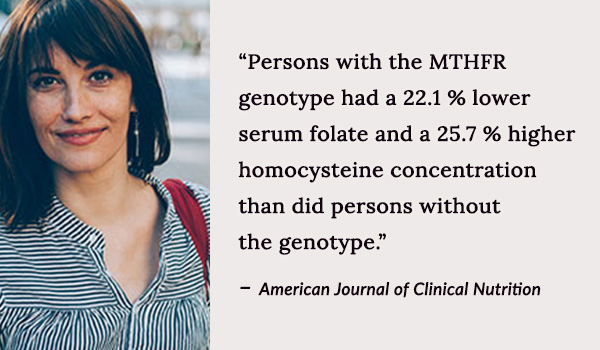
Some women have one or more small changes in a gene called MTHFR (short for methylenetetrahydrofolate reductase). The most common versions are called C677T and A1298C.
This may sound complicated, so let’s simplify it.
If you have one — or especially two — of these changes, your body may not process certain vitamins, like folate and B12, as well as it should. This can affect things like your mood, energy, hormones, detox and even your risk for health issues like heart disease or pregnancy problems.
The good news is that there are simple things you can do to help your body work better, even with this gene mutation.
Take the right kind of vitamins: One of the most important steps you can take to support your health—especially if you have an MTHFR mutation—is to make sure you’re getting the right forms of key nutrients, particularly folate and B vitamins.
- Folic acid (the synthetic form of folate) may not be processed well by people with MTHFR mutations. Instead of regular folic acid, choose supplements like our Essential Nutrients that come formulated with methylfolate (5-MTHF) and methyl B12 (methylcobalamin). These are already in their active forms, so your body can use them right away. The standard recommended dose varies, but many practitioners recommend doses ranging from 400 mcg to 1,000 mcg daily. In some cases, higher doses may be used, depending on individual needs.
- Vitamin B12 (in its active form, such as methylcobalamin) and Vitamin B6 (pyridoxal-5-phosphate) may be helpful for those with MTHFR mutations. These vitamins support methylation and help compensate for impaired folate metabolism.
- Vitamin B2 (riboflavin) can also support MTHFR function and be beneficial for those with mutations.


Eat whole, nutrient-rich foods: Leafy greens like spinach and kale, eggs, beets, legumes, avocados, citrus fruits and liver are great sources of natural folate and other B vitamins.
Avoid highly processed foods that strip nutrients. Foods fortified with folic acid like breakfast cereals and breads are best avoided since synthetic folic acid may not be well utilized.
Limit alcohol and toxins: Since detoxing may be harder with this mutation, cutting back on alcohol and reducing exposure to chemicals (like in plastics or cleaning products) helps lighten the load.
Support stress management: Chronic stress can make methylation problems worse. Try calming activities like walks, deep breathing, yoga, journaling or prayer.
Exercise: Regular physical activity helps support healthy methylation and overall well-being.
Check your homocysteine levels: A simple blood test can show if this waste product is too high, which may mean your methylation isn’t working well, increasing the risk of cardiovascular disease, pregnancy complications and other health issues. Supplementing with methylated folate and B vitamins can help lower homocysteine.
Pregnancy considerations: Women with an MTHFR mutation are often advised to consult with their healthcare provider before pregnancy. Some may be at a higher risk for complications like preeclampsia, miscarriage, or neural tube defects.
A doctor might recommend higher doses of methylated folate before and during pregnancy to reduce these risks.
Other Health Considerations: For women with certain conditions associated with MTHFR mutations (e.g., recurrent miscarriage, blood clotting issues or cardiovascular disease), a healthcare provider might recommend additional treatments or other medications to manage these risks.
Talk to a knowledgeable doctor or healthcare provider: Many conventional doctors don’t yet test for MTHFR, but a functional medicine or integrative practitioner can help you understand your unique needs. It’s important for women with MTHFR mutations to work with a healthcare provider to develop an individualized treatment plan tailored to their needs. The approach can vary depending on their overall health and specific mutation type.
If you have a family history of chronic illness, fertility struggles or inflammation-related conditions, now is the time to ask your provider about testing for the MTHFR mutation.
Even without testing, one simple step you can take today is to switch to a high-quality multivitamin that contains methylfolate and active B vitamins. It’s a small change that can make a big difference in how your body feels, functions and protects your future health.


Shop our solutions
Doctor-formulated. Science-backed. Proven in practice. Made in the USA. Batch-tested. FDA-inspected labs.
References and further reading
References
Ledowsky, Carolyn Jane, Janet Schloss, Amie Steel. Variations in folate prescriptions for patients with the MTHFR genetic polymorphisms: A case series study. Endeavour College of Natural Health, now at University of Technology Sydney, Faculty of Health, Australia, Southern Cross University, Natural Centre for Naturopathic Medicine. Exploratory Research in Clinical and Social Pharmacy. June 2023.
Klerk M, Verhoef P, Clarke R, et al. MTHFR 677C→T Polymorphism and Risk of Coronary Heart Disease: A Meta-analysis. JAMA. 2002;288(16):2023–2031. doi:10.1001/jama.288.16.2023
Simon Gilbody, Sarah Lewis, Tracy Lightfoot, Methylenetetrahydrofolate Reductase (MTHFR) Genetic Polymorphisms and Psychiatric Disorders: A Huge Review, American Journal of Epidemiology, Volume 165, Issue 1, 1 January 2007, Pages 1–13