



Menopause is inevitable. Your symptoms aren't.


Reviewed by Dr. Sharon Stills, NMD
You came here looking for answers. The belly fat that showed up out of nowhere. The crazy hot flashes. The fatigue that drops you at three in the afternoon like a trapdoor.
You know it’s about menopause. But it’s actually something bigger.
Here’s the truth almost no one tells you: these symptoms aren’t menopause. They’re not even really about your age. They’re your hormones — the whole connected system — asking for help. And that system has been under strain for years.
You’ve been misled about menopause — so thoroughly misled that it’s hard to know where to start. So let’s begin with these four:
- You’ve been told your symptoms come from declining estrogen. That’s not true.
- You’ve been told your body is failing you — that you’re helpless, maybe doomed. That’s more marketing than medicine.
- You’ve been offered drugs like a magic potion. They do more for symptoms than underlying causes.
- You’ve been told your hormones are wild and unruly. They’re not. They’re a language — and you can learn it.
You deserve the real story here, because that’s how you’ll get your health back. That’s what this page is for.
What is menopause, really?
Menopause is natural. It’s the close of your fertile years — the mirror image of puberty. One ramps your cycles up. The other winds them down. Nothing breaks. Nothing fails.
Done right, it should barely register. In much of the world, it still doesn’t. So why does it wreck so many women here?
Start with what menopause actually is. Technically it’s a single day: the day twelve months have passed since your last period. In America the average age is 51. The years before it are perimenopause. Everything after is post-menopause.
But that clean definition hides something. Women now suffer more symptoms, more severe, starting earlier and lasting longer than ever before. Some carry “menopause symptoms” into their 80s. That isn’t menopause. That’s hormonal imbalance no one ever resolved — and medicine rarely mentions it.
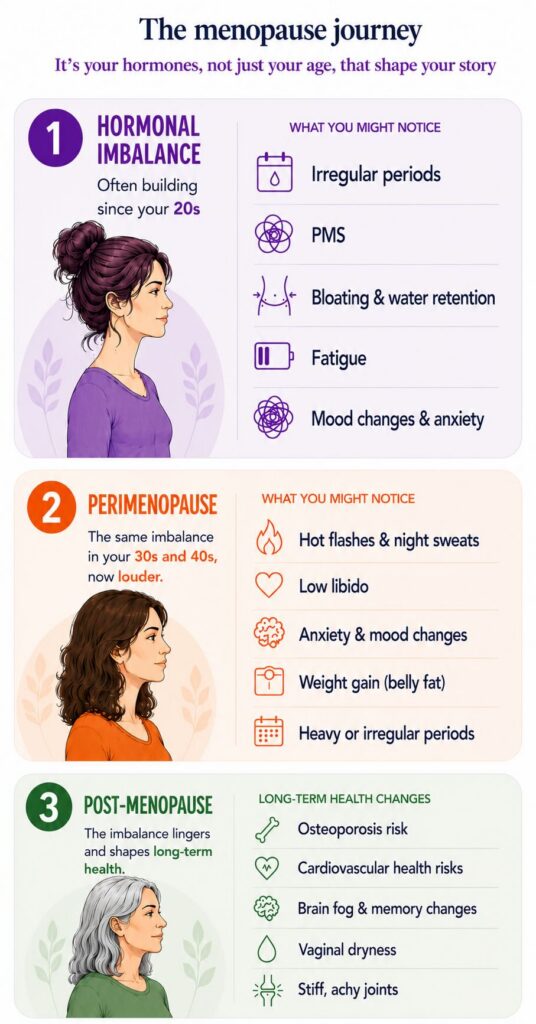
It helps to see the whole arc as three phases of one story:
- Hormonal imbalance — often building since your 20s, showing up mostly as period trouble, sometimes with lots of noise.
- Perimenopause — the same imbalance in your 30s and 40s, now louder.
- Post-menopause — usually quieter symptoms but most of the same imbalance, still unresolved, sometimes for decades.
One thread runs through all three, and it isn’t your age. It’s the state of your hormonal system — and that you can fix.
Why are there so many symptoms of menopause?
The simple answer: because it isn’t just menopause.
Count them: hot flashes, night sweats, insomnia, brain fog, weight gain, joint pain, thinning hair, dry skin, low libido, anxiety, crashing fatigue. And at least a dozen more. No single gland could cause a spread that wide. One thing could — a whole system out of balance.
Here’s the part no one explains. Your hormones don’t work alone. They work as one connected network — brain, gut, adrenals, thyroid, ovaries, metabolism — all talking at once. An amazingly complex system. Move one, and you move them all.
That’s why symptoms cluster and dysfunction evolves into patterns. Each cluster points to one part of the network asking for help:
- Heat — hot flashes, night sweats, palpitations. Basic self-regulatory functions that stop working.
- Sleep and energy — 3am waking, fatigue that sleep won’t fix. There’s a circadian rhythm to all of this, and it’s been lost.
- Mind and mood — brain fog, anxiety, mood swings. Most women don’t realize that hormones in the body are neurotransmitters in the brain.
- Body — belly fat, joint pain, thinning hair. Your metabolism runs on hormonal signals. Scramble the signals, and it stores fat and slows regeneration.
- Sex and cycle — irregular periods, dryness, low libido. Clear signs the body can’t keep up.
- Gut — bloating, cravings, constipation. Your gut both makes and depends on hormones. It’s all connected.
None of your symptoms are random. Every symptom is a message. Read together, they tell you where your system needs support. That’s the opposite of “unpredictable.” And it doesn’t mean your complex body needs to be overruled by a drug, either.
Why do some women struggle and others don’t?
Every woman goes through menopause. Estrogen falls in all of them. So why do some sail through while others fight for a decade?
It isn’t declining estrogen. The women who struggle most don’t have the lowest estrogen. They have the most strained systems.
Walk into menopause with a well-regulated system — good sleep, steady blood sugar, low inflammation, a calm stress response — and the transition is easy. Your body adapts. Walk in with a system already running on empty — years of stress, poor fuel, a struggling gut — and the same downshift hits like a tornado in a thunderstorm.
This is why symptoms can start in your 30s, when estrogen is nowhere near declining. Studies show women in advanced countries carry higher-than-normal estrogen levels. The imbalance was already there. Menopause didn’t cause it. It exposed it.
There’s no such thing as an average woman, but the rule holds: the stronger your system going in, the easier the passage.
[Take the Menopause & Perimenopause Quiz — find out where you are →]
If it isn’t declining estrogen, what upsets my hormones?
Here’s the gap. Science has made amazing progress in understanding what drives hormonal imbalance. Conventional medicine — what happens in daily practice — hasn’t kept up.
The science points to nine factors that derail hormonal balance. Conventional medicine points to declining estrogen — partly because there’s a drug for that, and a drug is easy to prescribe in a six-minute doctor visit. Estrogen makes a convenient culprit. But it’s just taking the fall.
So don’t be surprised that your doctor won’t walk you through the 9 Factors. But you need to understand them and how they evolve into patterns (called phenotypes in the science) — because that’s how you learn the language of your symptoms and how to fix what’s gone wrong.
Factor 1: Chronic stress
The master disruptor. Cortisol takes priority, sex hormones lose their supply, and the whole endocrine chain is knocked off balance. Not because your ovaries gave up — because cortisol is a kind of endocrine bully.
Factor 2: Sugar and refined carbs
Insulin is a major hormone too. Blood-sugar swings raise cortisol and deepen the drain, then lock you into a fatigue-and-craving loop that looks like a willpower problem and isn’t. Cortisol also makes trouble for insulin.
Factor 3: Poor nutrition
Your body builds hormones from raw materials — cholesterol (the basic building block), magnesium, B vitamins, zinc, omega-3s. Run low for years, and you force your body into harmful adaptations.
Factor 4: A damaged microbiome
A community of gut bacteria — the estrobolome — governs how you process and clear estrogen. The gut also makes and processes other hormones, and helps regulate hormonal balance.
Factor 5: Excess weight
Fat tissue makes its own estrogen — noise that confuses the system. Imbalance stores fat; stored fat worsens imbalance. A loop, nothing broken.
Factor 6: Too little movement
Exercise lowers cortisol, steadies insulin, clears used hormones, cools inflammation, and more. Inactivity derails natural balance.
Factor 7: Many medications
Antidepressants, acid blockers, steroids, long-term birth control — each has hormonal effects. Not an argument against them, but we need to see their role.
Factor 8: Systemic inflammation
Sustained inflammation disrupts hormonal balance in multiple ways, impairing endocrine gland function as well as hormonal signaling. And it feeds on itself: imbalance drives inflammation, and inflammation deepens the imbalance.
Factor 9: Glandular damage
This is where it turns serious. Leave factors 1 through 8 unaddressed for years, and the imbalance stops being a response and starts becoming damage.
The adrenals — meant to bridge hormone production as the ovaries wind down — grow exhausted. The thyroid slows, with knock-on effects. The ovaries, under constant strain, can’t support fertility and may ultimately fail prematurely.
This is the doom loop: damaged glands can’t rebuild what damaged glands lost. The imbalance becomes the condition. Not a phase. A state.
There are two points to make about the 9 Factors. First, they aren’t inevitable. Second, you’re going to have to step up and support your body — you aren’t likely to hear about the 9 Factors, or how to deal with them, from your conventional doctor.
What conventional medicine gets wrong — and why
Be clear: your doctor isn’t the enemy. No one is hiding the truth from you. The problem is built into the system — its training, its clock, its tools.
The standard answer to menopause is hormone replacement therapy — HRT, now often called MHT. For some women it’s the right call: severe symptoms, surgical menopause, menopause before 45. And modern bioidentical HRT isn’t the synthetic HRT that alarmed everyone in 2004. The science has moved on. If you’re weighing HRT, that’s a real conversation to have.
But here’s what HRT doesn’t do, even when it fits: it doesn’t touch the underlying causes. It overrules your biology. Stop it without addressing the nine factors underneath, and the symptoms return — because nothing that caused them has changed.
Why does conventional medicine miss this? Lack of training, to start with. Medical school spends little time on hormonal health and almost none on nutrition, the gut, or lifestyle. Time is another reason. A six-minute appointment can’t untangle nine connected variables. The doctors who go deep almost always learned it on their own time. It’s a curriculum problem that keeps the old medical model from changing.
You deserve more than symptom management. You deserve the whole picture your symptoms are asking for.
[Wondering if you actually need HRT? Take the quiz →]
What actually works to restore balance — before, during and after menopause
If the imbalance is system-wide, the fix has to work with the system — not override it. That’s the whole idea behind botanical medicine, and behind a class of plant compounds called phytocrines.
Phytocrines are plant molecules shaped like your own hormones. Biologists have studied how they work, and they do three things. They bind to hormone receptors — gently, not with a drug’s blunt force. They mimic hormone action where tissues need it. And they nudge your body to make more of its own.
What sets them apart from drugs is one word: adaptogenic. A drug delivers a fixed dose and demands a result. A phytocrine opens a conversation. Your body takes what it needs and leaves the rest. That isn’t a weakness. It’s exactly what a system this complex requires.
As Dr. Tori Hudson, a leading voice in women’s botanical medicine, puts it: “Many herbs have been used traditionally by herbalists and women for decades, and in some cases centuries, to address menopausal symptoms. Although many of the traditionally used plants lack clinical studies for this purpose, the empirical evidence and tradition are strong.”
The science keeps catching up to what herbalists saw all along — specific compounds, specific receptors, specific pathways.
Herbal Equilibrium
Herbal Equilibrium is WHN’s version of that approach — seven botanical extracts chosen for their modern evidence and their combined adaptogenic effect.
- Red Clover — isoflavones that support estrogen signaling where it’s needed.
- Kudzu — added phytoestrogen support, especially for temperature.
- Wild Yam — supports progesterone pathways and the adrenals.
- Chasteberry — acts on the pituitary to steady the whole signaling chain.
- Ashwagandha — an adaptogen aimed straight at cortisol and adrenal strain.
- Passion Flower — calms the nervous system, easing sleep and anxiety.
- Black Cohosh — a long-trusted botanical for hot flashes and mood.
Each herb works one way. Together they support the system as a whole — not just the symptoms on the surface.
The formula is adaptogenic by design. Your body uses what it needs. Two women, same capsule, different results — because their systems have different needs. That’s not unpredictability. That’s the body doing its job.
What women feel: the first shifts are quiet — a hot flash a little milder, a night a little deeper. Over weeks they build. Real relief takes months, because the goal is restoration, not suppression. This isn’t a quick fix. It’s a different kind of fix. It lasts.
Herbal Equilibrium holds a 4.4/5 rating across 579 reviews. A 30-day supply is $44. On subscription, $37.40 a month.
Common questions about menopause
Do my symptoms mean I’m in menopause?
Maybe — or maybe perimenopause, which can start in your 30s. The clue isn’t your age. It’s the pattern of hormonal imbalance. When symptoms cluster — heat, sleep, mood, weight, cycle — that’s hormonal imbalance talking, whatever your birthday says. The Peri/Menopause quiz [link] maps your pattern in about five minutes.
My doctor wants me to start HRT. Should I?
That’s your call to make with your doctor — we’d never tell you to ignore medical advice. HRT helps some women, especially with severe symptoms or early menopause. But it manages the signal; it doesn’t fix the system. Many women get the relief they need from a natural approach first. And if you do add HRT, the natural approach works right alongside it. In our view, the natural approach should always be your first-line therapy, whether you use HRT or not.
Aren’t menopause symptoms just a normal part of getting older?
Normal and inevitable are very different. Your hormonal landscape does change with age. Feeling terrible doesn’t have to. Most of what women blame on age — fatigue, weight, fog, low mood — traces back to imbalance you can address.
Can menopause symptoms really be fixed naturally?
For most women, most of the time — yes. Hormones are built from nutrients, steadied by sleep and stress, cleared by the liver and gut. Support your body’s self-regulatory power and you support its balance. Some conditions need medical help too. The two aren’t enemies.
Why do my symptoms keep coming back?
Because the cause was never addressed. Suppress a symptom and it returns. Restore the system and it settles. That’s the difference between managing menopause and moving through it.
Your body always wants to heal.
You knew something was off. And it wasn’t your imagination.
But now you know what the language of your symptoms means, and the support your body is asking for.
That’s why your menopause isn’t an ending — it’s the beginning of a new, healthier relationship between you and your miraculous body.
[Take the Menopause & Perimenopause Quiz — find where you are →]
Still have questions? Call us at 1-800-448-4919, Monday–Friday. You’ll talk to an experienced advisor right here in Maine. Your call is free.
WHN pioneered the natural approach to health 25 years ago, and still finds new ways to serve women. If you want a balanced approach that draws on the best of conventional and natural medicine — come join us.
Further reading
- How do I know if I’m in menopause?
- What is perimenopause?
- 14 signs of early menopause
- The real causes of hormonal symptoms
- Is it menopause, low thyroid — or both?
- Why are your hormonal symptoms back?
- 5 unique dangers of belly fat in menopause